Staff Shortages Are Real. Here's How Self-Service Kiosks Keep Service Running
Posted on 18 August 2026 by Maitri Bhavsar
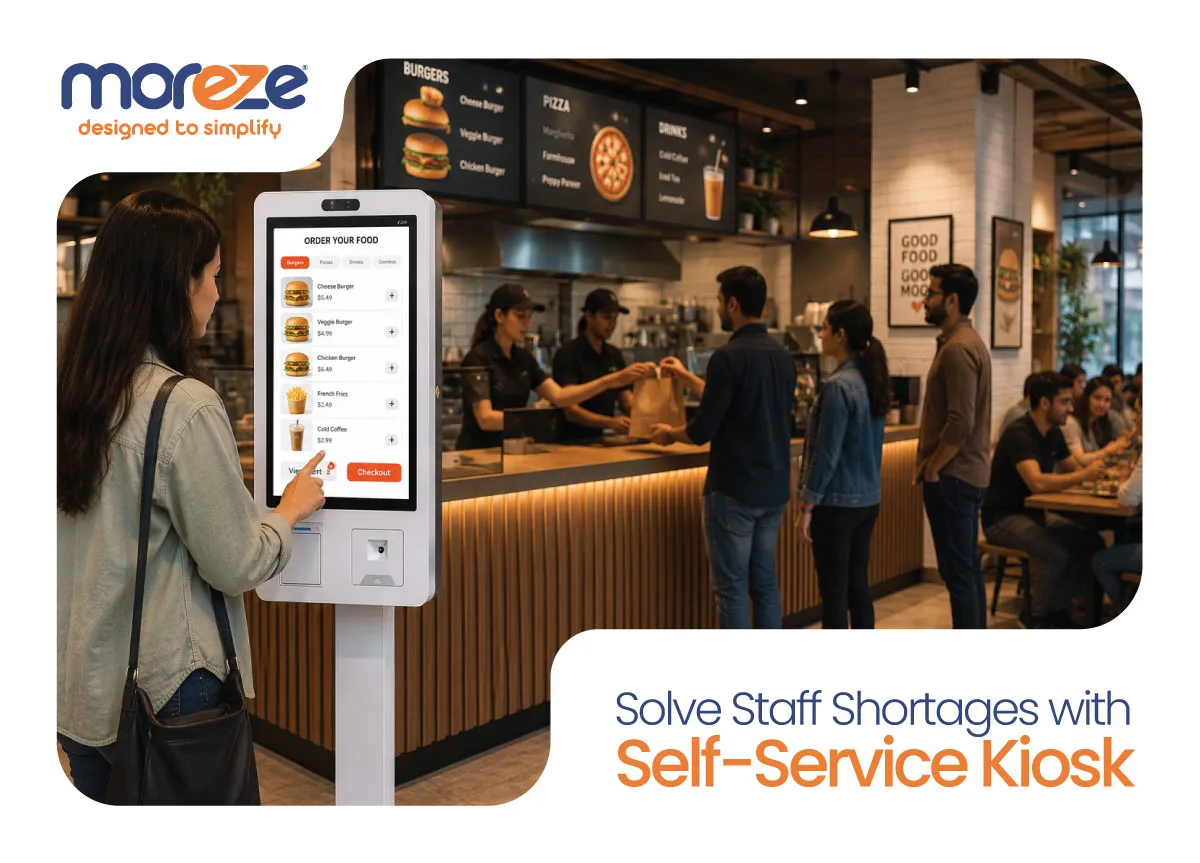
Walk into any busy restaurant during the lunch or dinner rush. The scene is almost the same: a line stretching toward the door, one visibly overwhelmed cashier, orders piling up in the kitchen, and customers glancing at their watches. Great food gets you in the door. However, getting it to the people quickly and consistently is what keeps them coming back. And honestly, that part is getting a lot harder!
Restaurants, cafes, QSRs, food courts, and corporate cafeterias are all dealing with the same pressures, such as labor costs climbing, turnover staying stubbornly high, and customers who expect faster service than ever before. Hiring your way out of it isn't always realistic, and when every order still runs through a single cashier, that bottleneck eventually shows up in your revenue.
This is why so many food service businesses are turning to self-service technology. A self-ordering kiosk isn't nice to have anymore; for a growing number of operators, it's become a core part of how they keep service moving, protect order accuracy, and give customers the experience they've come to expect elsewhere.
What Staffing Pressure Actually Does to Your Operations
If you think that front staff shortage stays contained, then you can't be more wrong. It spreads like wildfire!
Begin with the queue. When every order is handled by a cashier, lines form quickly during busy periods, and customers spend significant time waiting merely to place an order before the kitchen has even begun cooking it. That directly translates into dissatisfied customers, slower table turnover, walk-ins who feel it's not worth the wait, and a gradually declining satisfaction level.
Meanwhile, shift workers are doing far more than merely taking orders. They frequently greet clients while also describing the menu, processing payments, working with the kitchen, resolving inquiries and concerns. As traffic increases, maintaining a fast and accurate pace becomes nearly impossible for one or two persons.
Order accuracy typically fails at that point. Manual order entry allows for a lot of chances for misunderstandings in a noisy, high-volume setting, such as a misheaded item or a missing modification. Each error costs you wasted food, more prep time, a disgruntled customer, and decreased productivity.
Add to all of this the reality that consumers now demand the same level of ease from every other digital-first service they utilize: quick ordering, simple customization, short wait times, and first-time order fulfillment. Restaurants that are unable to deliver are gradually falling behind those that can.
Why Hiring More People Rarely Solves It?
It makes sense to hire more employees to address a staffing shortfall. In reality, such is rarely sustainable. Staffing fluctuates periodically, labor expenses continue to rise, turnover remains high, and all new hires must receive training before they can truly contribute.
The companies that are succeeding aren't adding additional employees to address the issue; rather, they are reconsidering the ordering process itself, which is precisely where self-service ordering technology makes sense.
How Self-Service Ordering Kiosk Removes the Bottlenecks?
An ordering kiosk replaces the counter, which is one of the busiest touchpoints in any restaurant. Customers use an easy-to-use touchscreen to browse the menu, personalize their meal, place an order, and pay at their own leisure rather than waiting on a cashier.
When you relieve your employees of that repetitive chore, several things happen simultaneously: wait times decrease, order accuracy increases, your team has more time for higher-value work, service is consistent even amid a rush, and the entire customer experience feels more seamless. The purpose of an interactive kiosk is to free up your employees' time for tasks like food preparation, quality assurance, and serving clients who truly require human interaction.
Here's how it looks in practice:
Shorter Queues: Instead of going via a single counter, multiple consumers can place orders at once, keeping things moving at the crucial moment.
Fewer Mistakes: There is no miscommunication or guesswork when consumers enter their own orders, complete with customizations, which results in fewer remakes and less food waste.
A More Productive Team: Employees are doing the job that genuinely enhances the experience rather than spending their entire shift keying in orders.
A More Professional Ordering Experience: Without feeling hurried by a queue behind them, customers may explore at their own time, review item descriptions, and construct their order.
Consistency, Even Under Pressure: Whether it's a holiday weekend or a Friday dinner rush, ordering continues to flow efficiently without relying solely on front-counter employees.
Meet OrderEze: A Restaurant Kiosk Solution Built to Simplify Ordering
It takes technology and software designed especially for restaurant automation in actual commercial settings to improve restaurant operations, not just a touchscreen fastened to the counter.
OrderEze is a self-service kiosk designed specifically for quick-service retail settings and restaurants by Moreze. It gives businesses a dependable option to streamline ordering while enhancing efficiency and the customer experience by combining sturdy, commercial-grade hardware with a sleek, contemporary UI. OrderEze adjusts to your service model without requiring you to redesign your workflow, regardless of whether you operate a single independent café or a chain of restaurants with multiple locations.
A More Personal Customer Experience
Using an easy-to-use touchscreen, customers can browse the menu, personalize meals, and place orders on their own. This is a quicker and more entertaining method of placing an order than standing in line.
Integration Without Disruption
OrderEze Self Service Kiosk is designed to integrate with your current restaurant software and point of sale system, allowing you to update ordering without completely overhauling your current setup.
Deployment That Fits For Your Space
OrderEze is available in freestanding floor mount, wall mount, and tabletop formats that may be deployed wherever it makes the biggest effect because every restaurant has different layout requirements.
Hardware Built For Daily Commercial Use
OrderEze's internal components include an industrial-grade touchscreen display running either Windows or Android, biometric authentication, an integrated thermal receipt printer, Wi-Fi, Bluetooth, QR/Barcode scanning, and unique branding possibilities, all supported by simple maintenance and support. Companies who require more features can add contactless card readers, and other peripherals to meet their unique needs.
It Is Not Just For Restaurants
OrderEze was designed specifically for QSR kiosk deployments and restaurants, but the same digital ordering kiosk technology works just as well in corporate cafeterias, food courts, hospitality venues, hospitals, schools, universities, and airports where customers are placing repeat orders under time constraints. OrderEze is suitable for any situation where a quick and simple food ordering kiosk experience is the main objective.
Where Restaurant Operations Are Headed?
Although staffing pressure won't go away anytime soon, it doesn't have to limit your ability to provide excellent customer service. Today, restaurants that invest in self-service restaurant technology are in the greatest position to manage demand during peak hours, maintain customer satisfaction, and maximize the productivity of their current workforce.
OrderEze offers restaurants a useful approach to streamline ordering, remove operational bottlenecks, and create a quicker, more dependable dining experience without sacrificing the individualized touch that draws customers in.