How to Reduce Canteen Queues & Improve Meal Service with Queue Management Kiosks
Posted on 21 September 2026 by Maitri Bhavsar
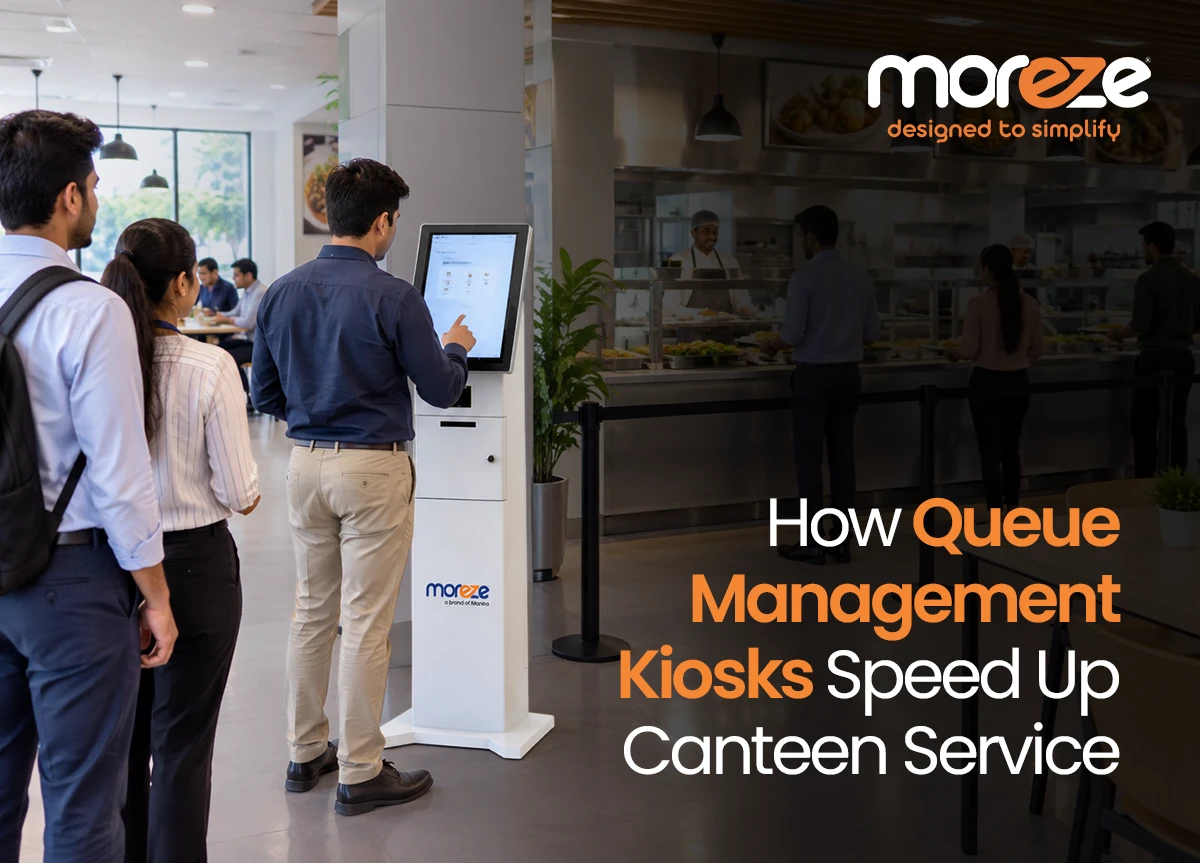
Long queues during lunch hours are a common bottleneck in corporate offices, factories, campuses and other high volume workplaces. Adding another counter or more staff may increase capacity, but it will not solve the underlying problem.
The real bottleneck is often the number of manual steps involved in serving each employee. Identity verification, entitlement checks, meal selection, payment or subsidy deduction, and transaction recording can all add time to a single interaction.
Queue management kiosks can reduce canteen waiting time by moving these repetitive steps to self service. Employees can identify themselves, access their meal entitlement, complete the required transaction, and move through the service point with less dependence on a cashier. This helps reduce counter congestion, improve transaction accuracy, and increase meal-service throughput during peak hours.
Why are Canteen Queues so Long During Peak Hours?
A canteen queue does not form simply because there are too many employees. It forms when too many people have to complete several manual processes through the same service point.
A typical manual transaction may require an employee to:
Identify themselves
Confirm their meal entitlement or balance
Place or Confirm Order
Calculate the amount payable
Make a payment or apply a subsidy
Collect the meal
Record the transaction
When hundreds of employees need to complete these steps within a short lunch or shift-break window, even a few extra seconds per transaction can create a significant queue.
Adding another counter can divine the queue, but if the same manual process remains at every counter, the underlying constraint remains.
How Can Queue Management Kiosks Reduce Canteen Waiting Time?
A queue management system reduces the number of manual actions required at the Point of Service.
Instead of relying on a cashier to enter every transaction, the kiosk can connect employee identification with meal entitlement, ordering, payment or subsidy processing, and transaction records.
This changes the service flow from a series of manual checks to a more direct digital interaction.
From a high-volume canteen, the impact becomes more significant as transaction volumes increase. Removing even a few seconds from each transaction can improve throughput across hundreds of employees during a single meal period.
How Do Self-Service Kiosks Improve Canteen Meal Service?
Self-service does more than move employees away from a counter. It can help reorganize how the entire meal-service process works.
A digital canteen management system can support:
Faster employee identification
Automated entitlement or balance checks
Self-service meal selection
Digital transaction processing
Real-time transaction records
Employee-wise consumption tracking
More accurate accounting
Reduced dependence on manual reconciliation
This gives canteen operators a clearer view of transactions while allowing employees to complete routine steps with less waiting.
For organizations operating on multiple store fronts or serving a mixed workforce of employees and contractors , a structured digital workflow can also make it easier to apply different entitlement rules and maintain consistent records.
Can Canteen Kiosks Reduce Meal Subsidy Leakage?
Queue Management is only one part of the problem in any subsidized canteen.
Manual systems can make it difficult to verify whether the person receiving a meal is actually entitled to it. Shared cards, tokens, coupons, or proxy collection can create gaps between recorded consumption and actual consumption.
A canteen management kiosk can link a transaction to a verified employee identity. Depending on the system, authentication can use methods such as smart cards, fingerprints, iris recognition, or other supported credentials.
Moreze’s canteen management system uses smart card and biometric identification with the POS terminal to verify an employee and check their balance or entitlement before authorizing a transaction.
This creates a digital record of who completed the transaction, what was consumed, and where the transaction occurred.
What happens when Employee Authentication Is Automated?
Manual identity checks add another step to every transaction.
With an integrated authentication system, the employee can be identified through the supported credential, while the system checks the relevant entitlement or balance automatically.
The transaction can then be recorded against that employee in real time.
This helps organizations address several common operational challenges:
Proxy meal collection
Shared or transferable credentials
Manual entitlement checks
Reconciliation errors
Unclear consumption records
Time spent maintaining paper or manual registers
The benefit is particularly relevant for organizations where canteen subsidies are tied to an employee's identity, attendance, shift, grade, or other eligibility criteria.
How Can Digital Canteen Systems Improve Accounting and Reporting?
A manual canteen can leave facilities and finance teams with a considerable reconciliation workload.
Tokens, registers, invoices, employee records, and vendor reports may need to be matched manually before the organization can determine actual consumption and subsidy costs.
A digital canteen management system can record transactions as they occur.
Depending on the deployment, organizations can use the transaction data processed to understand:
Which employee completed a transaction
Which item was issued
Which terminal processed the transaction
When the transaction was occurred
How much was charged or deducted from the balance
Consumption across shifts or locations
This gives finance & facilities teams a more consistent record for reconciliation and reporting.
How Can Organizations Build The Business Case For Canteen Queue Kiosk?
Before investing in a queue management kiosk, organizations should quantify the problems that already exist.
Start with Canteen & Subsidy Costs
Compare the most recent canteen billing with the employee headcount and consumption records. There are often significant differences, which expose the current process's weakness.
Measure Manual Administrative Work
Identify how much time facilities, HR, finance, or canteen teams spend counting tokens, reconciling registers, checking invoices,
Measure Employee Wait Time
Record average waiting time during busiest meal periods. A five-minute average wait and a fifteen-minute wait create very different operational outcomes when multiplied across hundreds of employees and multiple shifts.
Measure Peak-Hour Throughput
Look into the number of employees each service point can process during the busiest period. This helps identify whether the primary problem is ordering, authentication, payment, meal collection, or any other workflow stage.
These points will help you provide a more clear & practical basis to evaluate whether self service and queue management will help you improve the operations.
What To Check Before Choosing A Queue Management Kiosk?
A queue management kiosk should be evaluated as part of the complete canteen workflow rather than as an isolated terminal:
Employee Authentication
Check whether the kiosk you are planning supports the authentication methods required by your business.
Offline Resilience
Canteen often work for short periods of time and have high volume periods. Confirm how the system handles temporary transactions. Can it store the transactions locally, can it sync it later?
Multi-Site or Multi-Shift Support
Organizations with several canteens or shifts should check whether the system can manage different rules by location, employee category or shift.
HR & Payroll Integration
If your requirements include meal charges or subsidies to be reflected in the payroll, then you should check whether the canteen system can exchange the required employee & transaction data with existing HR or payroll system.
Service Workflow
Most importantly, map the kiosk back to the actual bottlenecks. If your main pain point is identity verification or entitlement validation then the kiosk should address that specific step rather than adding one more screen in the mix. '
This is the point where selecting the right canteen management solution becomes imperative. A kiosk should feel like part of a wider service workflow, connecting employee identification, entitlement verification, and transaction processing rather than fictioning as an isolated self-service terminal.
For organizations looking to improve this complete workflow, Moreze Canteen Management System brings these functions together through an integrated kiosk based approach.
Why Moreze for Canteen Management?
Moreze's canteen management kiosk is designed to digitize key stages of employee meal management, including identity verification, entitlement validation, transaction processing, and reporting.
This kiosk approach ties employee identification to the canteen transaction, enabling the organization to reduce manual counter transactions while providing an electronic audit trail for all transactions.
For organizations with a large employee base, multiple shifts, subsidized lunch programs, and multiple canteen locations, this represents a disciplined approach to improving service while providing the necessary visibility into operations for both the canteen and finance organizations.
Wrapping Up!
Reducing canteen queues starts with identifying the bottlenecks. By automating employee identification, entitlement checks, ordering, and transaction processing, queue management kiosks can help organizations deliver faster meal service with better control & visibility.
For high footfall workplaces, the right canteen management system can turn a crowded manual process into a more efficient & connected service experience.
Frequently Answered Questions
A queue management system organizes the flow of employees through a canteen by managing activities such as employee identification, ordering, entitlement verification, payment, and transaction processing. When combined with self-service kiosks, it can move routine interactions away from staffed counters and help reduce waiting and congestion during peak meal periods.
A kiosk can solve queue problems by automating repetitive steps that would otherwise be handled manually at the counter. Employees can identify themselves, check their meal entitlement, select or confirm an order, and complete the required transaction through self-service. This reduces the processing time per employee and can improve throughput during busy periods.
A canteen management system kiosk can help reduce waiting time, limit counter congestion, improve transaction accuracy, automate employee authentication, maintain digital consumption records, simplify accounting, and reduce manual administrative work. The benefits depend on how the kiosk is integrated with the organization's wider canteen workflow.
Organizations should evaluate employee authentication, peak-hour transaction capacity, offline resilience, multi-site and multi-shift support, HR or payroll integration, reporting capabilities, and compatibility with the existing canteen workflow. The system should address the specific bottleneck rather than simply add another service terminal.
Self-service kiosks reduce queues by allowing employees to complete routine interactions without relying entirely on a cashier. Automating identification, entitlement checks, ordering, payment or subsidy processing, and transaction recording can reduce the time required at each service point.
Canteens can reduce peak-hour waiting time by identifying the steps that create the bottleneck and automating repetitive transactions. Self-service ordering, digital authentication, automated entitlement checks, and faster transaction processing can help increase throughput when large numbers of employees arrive within a short period.
Yes. Moving ordering, authentication, or other routine processes to self-service can reduce the number of employees waiting for assistance at a staffed counter. This can help distribute demand more effectively during lunch and shift-change periods.
A system that links transactions to verified employee identities can reduce fraud patterns involving proxy meal collection, shared credentials, or unverified access. The level of control depends on the authentication method and system configuration.
A suitably designed system can support multiple locations and shifts while applying different entitlement rules based on location, employee category, or shift. This is particularly useful for organizations operating several facilities or canteens.
Integration is possible when the canteen system and the organization's HR or payroll environment support the required data exchange. This can help manage employee records, meal deductions, and transaction reconciliation with less manual intervention.