Why Queue Kiosks Are Replacing Manual Queue Management
Posted on 24 August 2026 by Maitri Bhavsar
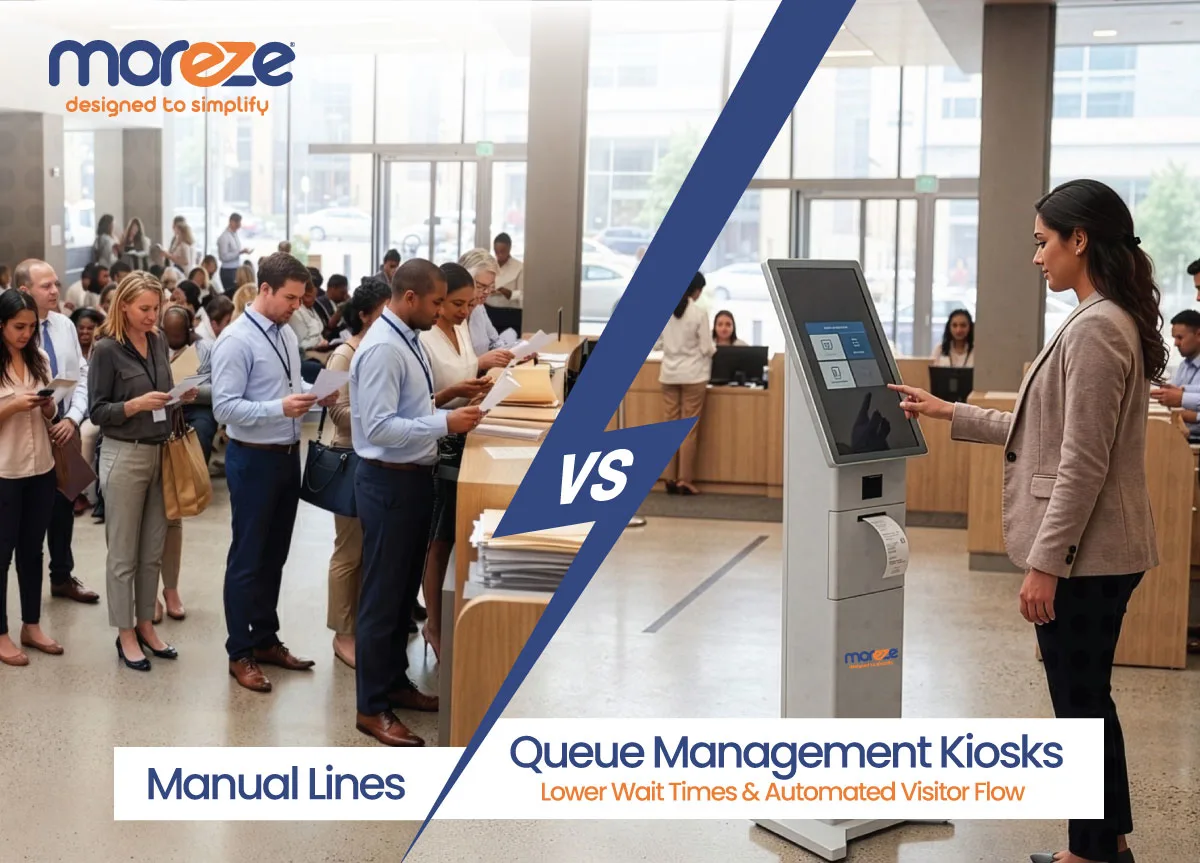
Walk into any busy hospital, bank, or government office today and you will notice a quiet shift. The familiar crowd around the counter, the paper tokens, and the verbal instructions are slowly disappearing. In their place stands a screen, a ticket printer, and an orderly flow of people who know exactly where they stand in line.
This change is not superficial. It is an integral part of the new approach to operations, to time, to people, and their expectations. A queue management kiosk is no longer a nice-to-have. It is the basis of many operations for organizations that rely on providing services to customers.
The Breaking Point Of Manual Queues
Manual queues are a product of the past. Reduced pedestrian flow, a lower variety of services, and laxer accountability practices sufficed in the past. Nowadays, they are rendered useless by several factors.
When comparing manual vs automated queue management, the weakness is similar in most cases. The manual approach relies on human initiative and decision-making, verbal communication, and written record-keeping. In addition, there are a lot of opportunities for mistakes to occur, which means that waiting time can be unpredictable, and clients may get frustrated easily.
The comparison between queue kiosk vs manual token system makes this clear. A paper token only tells a customer their number. A digital system tells them how long they might wait, where to sit, and when to approach the counter. That difference alone changes behavior and perception.
For organizations handling hundreds or thousands of visitors a day, the decision to replace manual queue management is often triggered by complaints, staff burnout, or visible service breakdowns. Many are now planning to upgrade from manual queue systems before those problems escalate further.
What Queue Kiosks Actually Change
At a functional level, a queue kiosk system for service centers automates the most delicate elements of the service process. The procedure is organized so that users can register themselves, choose the service they want, and queue without disrupting the process. In addition, personnel can provide services without worrying about the flow of visitors.
Systems that employ self-service and introduce structured queuing can reduce wait time significantly. Eighty percent of surveyed participants said they would feel that their wait time was shorter, while technology vendors reported between 30 and 35 percent decrease in wait time, along with reduction of operating costs and improvement in staff productivity.
A good automated queue management solution not only helps in the issuing of tokens but also ensures that the queues are distributed amongst the available counters and prioritized according to set criteria. Moreover, it also facilitates dynamic adjustment based on the rate of service being provided. As such, many entities are beginning to view the digital queue management system as an integral part of their infrastructure as opposed to the front-desk systems.
The development of the smart queue management kiosk also has the advantage of flexibility. Touchscreens, the availability in several languages, accessibility options, and configurable back-end systems allow the same product to address a variety of settings from multinational corporations to small local shops.
Transparency Changes Customer Behavior
One of the most unexpected but valuable benefits that queue kiosks bring to organizations is transparency. It has a surprisingly powerful effect on people's behavior - and not only that, it also significantly reduces the stress of waiting before service.
What transparency enables
Fewer repeated questions at counters
Less jostling and tensions
Easier to keep waiting areas manageable
A digital queuing process injects transparency into the often-frustrating process of waiting. This alone can improve tensions at the front lines.
Crowd Handling at Scale Is no Longer Optional
One of the key areas where manual processes are notably deficient is crowd management, especially during peak times. Large-scale operations typically do not grapple with unpredictable demand. Instead, their primary challenge lies in accommodating surges in demand that the existing manual queuing system cannot efficiently handle.
Queue management systems are known to reduce the feeling of waiting by half and increase staff productivity by relieving them of direct responsibility for queues, thus allowing companies to optimize the use of resources at service counters.
In high traffic environments, the queue kiosk can provide necessary relief. They provide control to avoid confrontations, save space, and provide a means for orderly progression even when crowds erupt. For large multi-counter facilities it is a very important tool to controlling crowds and enabling continued operations.
As the scale of the operations grows the problem changes from managing a workforce to managing the flow of traffic. It is in these circumstances that automated queuing systems demonstrate their fundamental advantage over human-led organization of conferences, in that they can handle thousands of people within a timeframe more efficiently than one person alone.
Designing for Peak Hours, not Average Days
As the scale of the operations grows the problem changes from managing a workforce to managing the flow of traffic. It is in these circumstances that automated queuing systems demonstrate their fundamental advantage over human-led organization of conferences, in that they can handle thousands of people within a timeframe more efficiently than one person alone.
Controlled use of resources on a surge
Balancing loads across counters
Orderly, free of staff interference
These are the reasons why queuing kiosks are seen as mechanisms of resilience by more and more businesses rather than just an aid to efficiency.
The ROI Case Decision Makers Care About
Although often discussed in qualitative terms, the benefits of the queue automation solution are greatest at the quantitative level. The companies that implement the queue kiosk see increases in percentage of services performed and decreases in percent of patrons leaving the queue. By reducing the subjective length of time spent waiting in line, businesses can boost satisfaction among their customers.
What the numbers typically show:
Streamline self service through reduced manual interactions
Increased counter productivity
Showcase ROI through Lower overtime costs
Lower escalation rates
Higher throughput per day
In addition, there is the impact on the workforce. Queuing kiosks allow a company to shift the staff from managing crowds to providing a better service, thus enabling the organization to scale up the number of customers it serves without increasing workforce.
Standardization Without Losing Flexibility
Manual queues are inherently somewhat subjective to the people waiting in them; two service counters offering the same service can't both be seen as taking exactly the same amount of time by everybody. They are dependable, but non-essential.
How kiosks balance control and flexibility
Standardized service rules across counters
Configurable priorities for specific cases
Localized workflows within a central framework.
The reason why large organizations utilize queue kiosks when scaling is that they are allowed to reach the expected rate of expansion while keeping the intricacies of the process.
Compliance, Auditability, and Accountability
Manual queue handling leaves little trace. When issues arise, it is hard to prove what happened, when, or why. Queue kiosks quietly solve this problem.
Operational advantages decision-makers value
Timestamped service records
Auditable service flows
Data-backed answers to complaints
The reason why large organizations utilize queue kiosks when scaling is that they are allowed to reach the expected rate of expansion while keeping the intricacies of the process.
Why Certain Industries Are Moving Faster
Adoption is accelerated in cases where waiting has immediate repercussions.
A hospital queue management kiosk system facilitates triage, segregation, and de-cluttering of the hospital environment. In an environment where order equals life, the benefits speak for themselves.
Banks face different pressures. A bank queue management kiosk helps manage peak-hour surges, service prioritization, and compliance without overloading staff.
Public services are seeing rapid uptake. Government service queue kiosks improve predictability, while a queue management system for public offices supports fairness and transparency. In busy locations, high football queue management becomes essential for daily continuity.

Moving From Interest to Evaluation
Once the decision-makers have identified their requirements, the emphasis switches to the fit and scale.
Managers will now look for the best queue management kiosk for service centers that matches their servicing mix and anticipated volumes at an acceptable level of reliability. A queue management kiosk for customer experience is evaluated in terms of its ease of use and visual appeal in addition to hardware power.
Growth readiness is essential, a scalable queue management system for growing operations should be able to support additional counters, services, and locations without redesigning the entire system. This is why most companies are choosing queue kiosks for their fast and controlled service that scales up as the business grows.
In a dense environment, reliability is critical. A proven queue management system for crowd management maintains order even during peak loads or sudden footfall spikes.
From Reactive Management to Predictive Planning
Manual queues force teams to react in real time. Queue kiosks enable planning ahead.
What data-driven queue systems unlock
Forecasting peak hours and staffing needs
Identifying recurring bottlenecks
Adjusting service design based on evidence
A queue management kiosk with analytics serves as a continual source of feedback that helps optimize layouts, staffing and more. This leads to enhanced performance gains.
Integration Is Where Real Value Emerges
Queue systems are valuable where they are applied, but they offer the most value when they are able to connect across points of sale.
A queue kiosk with a display informs the customer and decreases the need for staff assistance. A queue management kiosk with analytics provides information on wait times, traffic patterns, and staffing needs.
Larger deployments often rely on a centralized queue management platform to standardize service delivery across locations. At the same time, organizations look for a customizable queue kiosk that adapts to local workflows without breaking central control.
The Strategic Role of Queue Kiosks Going Forward
Queue kiosks started as front-desk tools. Today, they influence how services are designed, staffed, and evaluated.
Why leadership teams are paying attention
queue data reflects customer demand patterns
service delays become measurable, not anecdotal
operational decisions move from intuition to evidence
This shift explains why queue kiosks are now discussed in operational planning meetings, not just IT or facilities discussions.
Wrapping Up!
Queue kiosks are replacing manual queue management because service environments have changed. Higher footfall, tighter service windows, and rising expectations demand systems that bring order, visibility, and consistency by design.
What was once handled through staff coordination and paper tokens is now managed through structured flows, real-time data, and predictable movement. Queue kiosks make waiting measurable, crowd handling controlled, and service delivery easier to manage at scale.
For organizations evaluating this shift, understanding how interactive self service kiosks are designed, deployed, and adapted across real operations is often the next step. The Moreze queue management kiosk reflects how this transition is being approached in practice, with a focus on structure, scalability, and operational clarity rather than surface-level automation.